Fish days continued...
After proving my worth with a spoon I got
upgraded to a metal scaler—a coil of serrated rings for sending kampachi scales
flying in all directions. Kona kampachi is a new sashimi-grade fish sustainably
farmed in Hawaii since 2005. Prized for
its fat content of thirty percent and minimal fishy flavor, kampachi can be
served raw, baked or steamed.
Along the counters, the crew was busy
cracking crab legs, inspecting monkfish livers, carving up tuna blocks and
filleting mackerel. After pinching the
heads off a bucketful of smelt, it was back to the spoon to scrape at what was
left of a large salmon. My next task was
a clean process: packaging bright orange salmon roe (ikura) and wasabi flavored flying fish eggs (tobiko). At the next table
seven salmon heads are being split beneath a mallet-driven cleaver. With admirable patience, the fish boys put up
with my slow progress, keeping a wary eye out in case the gritty work made the
new girl vomit.
…
Slightly smaller than the state of
California, Japan has more than 18,000 miles of coastline. Of the many delicacies featured in Japanese
cuisine, one in particular can be found off California’s coast near Santa
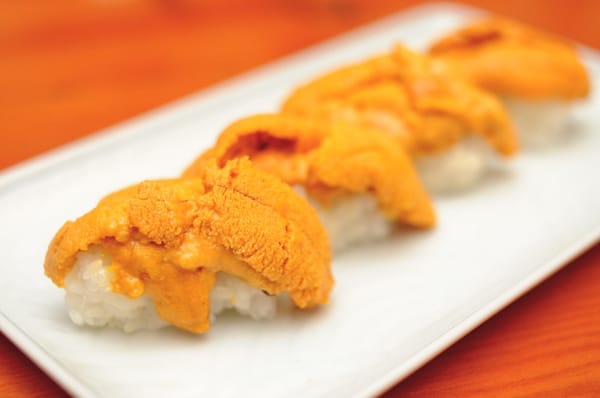
Barbara. Uni, the reproductive organs of red sea urchins, look like mustard-colored tongues with
a smooth, buttery taste. Santa Barbara uni
is harvested by divers and sold throughout the state, but the top quality
specimens are shipped off to Japan’s fish market in Tokyo. When choosing uni, look for firm pieces without areas of drying or
discoloration.
The Washington state coast also
offers up a rare culinary find. Mirugai in Japanese, the geoduck is the
world’s largest burrowing clam often prepared raw as sashimi. Monkfish liver (ankimo) and salted, dried herring
ovaries (kazunoko) are other delicacies for intrepid
foodies to try out.
How do you know if a fish is fresh? Smell it.
At the register, we cashiers cringed away from bags of fish heads and
grimaced at a waft of shellfish escaping from a bag. Behind the fish counter, I was unfazed by the
sight of dissected sea creatures with their open mouths and vacant eyes. With all of the visual distractions like the
arrival of 30-pound side of tuna, the role of smell takes a back seat. In a place so numbingly cold, it takes awhile
to pick up on scents beyond the initial waft of bleach. Although counterintuitive, fresh fish does
not smell fishy. A can of fresh scallops,
for instance, should in fact smell like canned corn.

I always wondered why Pete called out "corn!" (read fresh!) when opening up a batch of scallops.

No comments:
Post a Comment