Tuesday, June 19, 2012

A new Berkeley favorite: PIQ

I love Google Maps.
Planning a trip to Europe--complete with airplane, sun and sailboat icons.  


All this fun plus pizza rustica and a double latte at PIQ (Pane-Italiano-Qualite) on Shattuck Square.
The man behind the counter was having a grand time watching the Ireland-Italy match on the tele.

Delicious pizza and amazing coffee, fast/free wifi, extra upstairs seating and plenty of people watching.

Monday, June 18, 2012

The Fashion World of Jean Paul Gaultier in SF


“The fragmentation of time.  That’s fashion, the passing of time.”


Last week we took a spin through San Francisco Fine Art’s exhibit of fashion works by Jean Paul Gaultier.  Right away you are greeted by a talking mannequin with the face and voice of the designer clad in his signature Breton stripes. 

on the wall

Born and raised in Paris, Gaultier drew inspiration from the Parisian street scene.  His work in the 1970s included can-can inspired dresses and collections drawing on London in the time of Vivienne Westwood.  Sci-fi themes also appeared in Gaultier’s pieces through the incorporation of materials like vinyl and neoprene.  In 1976, Gualtier ran his first runway show. 

detail: mermaid dress


Gualtier’s collections in the 80’s include nods to the traditional apparel of Eastern European, Asian and African cultures.  The next decade found the designer busy working on costumes for films. 


A few of the ensembles in the exhibit took over 200 hours to complete.  The “Dubar” camouflage gown worn by Sarah Jessica Parker in 2000 was constructed in 215 hours.  Gaultier’s 2008 “Calligraphie” gown was 295 hours in the making. 

image: Fashionable Fun

Gaultier’s fall 2009 show included dresses inspired by Hollywood’s leading ladies like Mae West, Greta Garbo and Rita Hayworth.  The Marilyn Monroe dress was sequined by hand, all twelve pounds glittering down the runway.   

Tuesday, May 29, 2012

bring your own mug


On May 20, 2011, Seattle resident Karin de Weille took on the mushrooming problem of disposable cups.  In the city of caffeine, this was courageous campaign for sustainable consumption.  According to the Seattle Times, several local movements and businesses showed their support including one coffeehouse chain that raised its reusable mug discount from 10 to 25 cents.  “Let's show that we can do this and our success will be duplicated in other cities,” Seattle City Council President Richard Conlin was one of the supporters of Seattle’s campaign to kick to habit of disposable cups.

            Every year, Americans use 56 billion paper cups (International Paper).  Of this staggering amount of waste, Starbucks alone discards 3 billion cups.  According to International Paper, “Less than 2 percent of Starbucks beverages are served in reusable cups.”
While disposable cups are convenient for the consumer on the go, they are detrimental to the environment with their petroleum-based plastic lining.  Not only does this part of the cup delay the decomposition of the paper components, it is also produced from non-renewable materials (International Paper).
In response to this problem, International Paper, in collaboration with Green Mountain Coffee Roasters, designed the “ecotainer” in 2006.  Instead of plastic liner, the ecotainer uses a modified biopolymer resin which can be composted and ultimately reused as landscaping and farming material.  Thanks to this development in sustainable distribution, International Paper claims more than 1 million pounds of petrochemical plastic never made its way into the landfill.  
According to International Paper, half a billion of its ecotainers negated the use of “enough petroleum to heat more than 32,000 homes for one year.”  Since 2006, ecotainers can be found everywhere including at the UC Davis CoHo. 
         Clearly these companies thrive on the consumer mentality of disposable convenience.  If we were all more eco-conscious instead of profit driven, each paper cup would come with a discouraging statement about the unsustainable methods of producing and disposing billions of paper cups for our convenience.

If you visit the CoHo every morning as I do, you dispose of five cups every week.  That adds up to 60 cups every quarter—assuming you don’t make a second trip in the afternoon after the cup you used in the morning has already been disposed of.  This routine adds up to 5 disposable cups per week, amounting to $8 worth of small coffees.  This quarter alone, fueling my caffeine addiction has cost a total of at least $96 and at least 60 disposable cups. 

Guilt campaigns against plastic carrier bags are making headway, some stores charge you for requiring a plastic bag, others offer discounts for bringing your own reusable bag.  If Americans can ditch the convenience of one-time-use plastic bags, we can make it a habit to bring our own reusable cups to our daily coffee fill stations.  While it may be a pain to cart around a dirty empty container after your morning dose, just think of how many disposable cups you will have saved.  While your reusable coffee mug is not the first thing you grab on your way out the door, there is still time to change our cultural addiction to convenience.  

Insomniacs and apple toast


First the insomniacs: our house is running on three time zones: Pacific, GMT and Bhutanese.  


The past few days I’ve been back on Pacific, especially after I went to work on Saturday.  Dad is on his retirement schedule of early bedtime, 4am walkabout and getting up around 8.  Mom on the other hand: she’s still in bed around 10 or 11 because she was up reading/eating at 3am, a consequence of going to bed at 7pm and napping at 2pm.  She honestly scared me one morning at 3—all excited that I was up to witness her fluttering around the kitchen.  I was just waiting for a psychotic laugh to follow.  For a while I was doing the wake up at 2 and 5am thing and lying around thinking until 7.  So for a few days Dad had to keep a low profile, having to contend with both Mom and me being sleep deprived grouches.   
 
Apple toast:

This morning I fried up some thinly sliced apples in butter, dusted with sugar and cinnamon and ate over toast with fresh coffee.  Yum. 

Twenty-Something Travel and TEFL:

I love the blog Twenty-Something Travel—and the manifesto to travel while you’re young.  After soaking up a lot of advice, I bought the extra 38,000 miles to get me to Brussels this fall.  I’ve been back in the States for less than a week and I’ve already got my next escape lined up.  

Next spring I want to do Asia, after hearing so much about it recently.  No joke: Mom went one better than bringing home an elephant: she brought back a wooden penis, hand carved no less.  Apparently they’re everywhere in Bhutan to ward off evil spirits—as road posts, on temples, fountains… Where on earth is she going to put it?  Well it was on the kitchen counter while Dad and I were reading the paper/eating breakfast, trying to ignore it. 

Anyhow, since I haven’t done Asia yet I figured I might as well go on a TEFL program.  That way I can see a few countries and actually live there and see real people and help out/get certified.  It sounds better than taking methodology classes in Canada during November, although that option is still on the table.  


I've been listening to French language cds trying to brush up--mainly trying to beat the program in verb conjugation...  

Monday, May 28, 2012

coffee health pt 2


Academics such as Professor Roland Griffiths warn against abusing caffeine’s benefits.  A Johns Hopkins professor of psychiatry and neuroscience, Griffiths told Time Magazine that for coffee binge-drinking students especially, “the stress of the deadline can be exaggerated by the caffeine.”  Research conducted at Duke University suggests that your morning dose does its work to keep you awake for 12-16 hours before needing a revival (Time Magazine, “The Newest Addicts on Campus”).  At this point, you feel groggy and go to bed.  During sleep, the body is deprived of caffeine, making mornings especially difficult, only to be remedied by the much-needed morning dose of caffeine. 
This never-ending cycle is maintained by the body’s constant craving for caffeine and the ups and downs of withdrawal.  Drinking coffee, then, according to Jim Lane at Duke University, is necessary to “restore normal functioning rather than to feel more alert than usual” (Time Magazine, “The Newest Addicts on Campus”).


 A study by the Journal of American Diabetic Association revealed that 90 percent of adults consume caffeine every day.  Caffeinated beverages are clearly no longer simply symbols of upper-middle class leisure; we have become a culture desperately dependent on the coffee bean as a commodity, self-consciously perpetuating the cycle of withdrawal and temporary relief.
Whether you are hitting the books, procrastinating, or catching up with other sleep deprived friends, just remember: that cup of coffee connects you to a network of global trade and centuries worth of beans ground and consumed by fellow idlers across the globe.

Bargain Hunter's London


 A pile of dresses on the bed, boots and flats under the desk, jackets hanging in the closet and a collection of shirts on top of the tv.  I had made the mistake of waiting until my last night in London to pack a week’s worth of souvenir and bargain hunts.  With suitcase stretched beyond capacity, I made it home with a whole new wardrobe thanks to the high street and East End thrift markets.


The East End:

I love London’s east side—a year spent wandering the twisted streets revealed little pockets of good food and good shopping.  At first glance, the East End looks considerably rougher than the clean facades of London’s western postcodes.  Historically characterized as the immigrant and working-class region of the city, the East End is dynamic, ever surprising place to explore. 

Sunday is the day to be wandering: start at Liverpool Street Station and head east to Spitalfields Market.  There you can find stalls selling hand-printed shirts, vintage scarves, old books, posters, vinyl records and delicious pastries.  A session of digging through crates of dresses and skirts followed by coffee and an almond croissant is a great way to spend the morning.
Make sure to get cash the night before—there are only a handful of cash machines near by and they often run out of money.

A few blocks away is Absolute Vintage—a more organized vintage shopping experience.  Just next-door is the Sunday Up Market.  On Sundays, the nondescript parking garage is turned into a bustling market of new and vintage clothes.  Get there early to avoid the lunch crowd heading in to sample the food stalls cooking up pad thai, green curry, sushi, crepes, cupcakes and more. 
 
Just outside is Brick Lane, the curry center of London.  Together with street vendors, little shops offer books, shoes and other curiosities.  For heavily discounted high street clothing, head down Petticoat Lane.  While bargains are plentiful so are pickpockets.  If you don’t mind a challenge, Petticoat Lane has some good buys to be found.  I got a navy blue pea coat with toggles for $15. 

Camden Lock Market:

Like Notting Hill’s Portabello Road market, without the antiques.  Known as the goth/punk scene of London, Camden is full of costume and specialty shops.  Unlike the East End, Camden’s market is open on Saturdays.  Past the sunglasses and t-shirt shops is the canal.  Here you can find the food stalls with samosas, eggrolls and chocolate-filled Brazillian churros.  The winding passageways beyond are packed with people and little shops.  I have found dresses for $8, unusual necklaces and piles of oversized sweaters (aka jumpers). 


Oxford and Regents Streets:

The bustling high streets with Topshop’s multistory flagship store, Selfridges, Hamley’s toy store and much more. If you want to avoid the crowds, Kensington’s high street further west has many of the same shops.   Primark, at the very end of Oxford Street, is one place where crowds cannot be avoided—two floors of trendy, medium quality clothes at low prices creates a shopping frenzy.  It’s all too easy to get sucked in, but if you’re selective you can emerge from the madness with some good finds.  Knowing there are obscure brands and unique vintage pieces just waiting in the East End, I like to wander the high streets and people watch.

 Clearly I’m biased to the East End,  but it’s definitely worth a Sunday morning if ever you find yourself in London—just make sure to save some room in your suitcase.  


Sunday, May 27, 2012

caffeine and health pt 1


The UC Davis CoHo is proof that the coffee culture continues to thrive.  Ed Andrade, who orders the coffee supply, substantiates this statement: every day, the CoHo consumes between 130 and 140 pounds of coffee beans. 
College campuses are ideal settings for the coffee market: with stressed out, sleep deprived students working to meet deadlines, caffeine is often central to the period of crash studying proceeding the week of exams. 

In 2006, Northwestern University conducted a study of 265 incidents of caffeine abuses reported to the US Regional Poison Control Center between 2001 and 2004 (Time Magazine, “The Newest Addicts on Campus”).  Most surprisingly, the average age of the subjects admitted was twenty-one years old.  “People are less aware of caffeine as a drug than they are of alcohol and other recreational drugs that people come upon in college,” says Duke University’s psychophysiology lab director, Jim Lane.  Caffeine is the world’s “most popular psychoactive drug” according to sources such as National Geographic. 
The 2011 Food & Health Survey conducted by the International Food Information Council Foundation examined consumer attitudes regarding topics of nutrition, health and food safety.  This study quoted the majority of Americans (69 percent) as moderate consumers of caffeine.  The size of the “average” cup of coffee in such studies has been critiqued as notoriously vague, ranging from 8- to 12-ounces. 
Time Magazine’s “The Caffeine Habit” published government statistics citing 60-120 milligrams of caffeine for every 8-ounce cup of brewed coffee.  For those of us who have built up a tolerance for caffeine, our bodies require higher and higher doses to achieve even the slightest effect.  The average coffee consumer may be ingesting over 300 milligrams of caffeine everyday.  In contrast, those who drink coffee less often can perceive a physical or emotional change with 1.5 ounces of strong coffee—a caffeine intake of a mere 20 milligrams according to Jeffrey Kluger of Time Magazine.


The first caffeine addicts in the cultural centers of the Ottoman Empire described the physical effects of caffeine as marqaha, defined by an increased heart rate and maybe even a temporary feeling of euphoria (Hattox).  Avid coffee drinkers today are more familiar with the withdrawal symptoms of fatigue, irritability or a pounding headache.


Saturday, May 26, 2012

get your fix


Coffee culture remains strong in Europe and the US.  A Reuters report in May 2011 by Nigel Hunt maintains the leader board of coffee consumers in favor of the US and Brazil—although Scandinavian countries hold the record in terms of consumption per capita.  With Starbucks Coffee International looking to expand its base in China from 450 to 1,500 outlets by 2015, as president John Culver told Reuters, China may well be the world’s next top consumer. 
(image: Financial Times)

In fact, on June 1st, 2011, Starbucks signed an agreement with Hong Kong’s Maxim’s Caterers Ltd.  This contract gives Starbucks “full control of more than half of the Starbucks retail stores in Mainland China as it looks to accelerate growth in the future.”  For Culver, this take over is “part of our broader strategy to build China as our second home market outside of the U.S."


According to data compiled by the International Coffee Organization, the total consumption of 60-kg bags of coffee beans in 2009 by the US alone, totaled to 21,435,967 bags.  Importing over 2,772 million pounds of coffee beans in 2009 alone, the US remains one of the top two consumers in the world.  
Brazil is both a top producer and consumer: in the ICO 2009 study, Brazil’s domestic consumption amounted to 18,390,000 bags, totaling 2,376 million pounds of coffee beans. 


Americans consume 25 percent of the world’s coffee market. According to the National Coffee Association, 167 million American coffee consumers downed 6.3 billion gallons of coffee last year.  As demonstrated by the International Coffee Organization’s 2009 data, the American per capita rate of consumption averages to 3.14 kg.  This is relatively low compared to Norway’s 8.92 kg per capita.  The world’s leader, in terms of per capita consumption, was Finland with 11.92 kg.  

Friday, May 25, 2012

back in the day


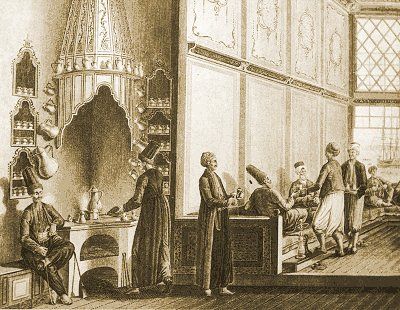
By the early-sixteenth century, coffee had necessitated the creation of its own institution: the coffeehouse.  With the spread of such novel public places throughout the Early Modern Ottoman Empire, a distinct culture of urban leisure began to take shape.  
For Ralph S. Hattox, author of Coffee and Coffeehouses, the coffeehouses of Istanbul were the new secular centers where the exclusively male cliental could exchanging ideas.  These medieval café dwellers were seen as “young idlers” and “professional loungers” participating in the unrespectable trend of ‘utlah, or ‘doing nothing.’  The scholar Kâtib Çelebi linked the coffeehouse culture of Istanbul with the city’s clandestine world of “loose living” (Hattox).  Despite the negative associations with the drink, coffee was and remains to this day, a public affair. 

European centers of commerce followed suit in the seventeenth century as coffee culture spread to London and Paris via Venice, then over to the American colonies. In his book Tastes of Paradise, Wolfgang Schivelbusch uses London as case study.  By 1700, the city boasted about 3,000 coffeehouses for its population of 600,000.

Lloyds of London, now a major insurance company, started out as a coffeehouse in the eighteenth century.

Coffee and tea were already international commodities by the seventeenth century, stimulating colonial investments and trade to cater to the emerging European culture of leisure.  Middle class intellectual culture was kept satisfied with goods from the colonies in a system much akin to the modern importation of coffee beans.

Thursday, May 24, 2012

“black as the devil, hot as hell, pure as an angel, sweet as love”


The best part of finals week: half priced coffee at the CoHo.
While the library is the prime study spot, the Coffee House is equipped with more than silent cubicles—with finals creeping up, the CoHo will be your best study buddy.
Walking into the UC Davis Coffee House you can feel the buzz--the music, the chatter, and the frantic flipping of pages.  Students with their noses in books fight through mental anguish amidst the distinct aroma of freshly-ground coffee.  


Every so often, a drink is made ready at the counter—calls to claim a “double mocha for Tom” or a “soy latte for Sophie” ring out through this oasis for students on their way to and from class, seeking that extra boost to get them through the day.  For some, myself included, a visit to the CoHo is part of the daily grind.  With a cup of coffee in hand, you can take on the day, fully caffeinated and ready for anything.
...
Everyday in every country, coffee is consumed by the gallons.  Coffee has fostered its own culture sparked by its mythical discovery in the ninth century.  Since then, the beans have become a commodity with a complex system of varieties, growers and distributers as complex as the wine industry.  Today, Americans are the world’s most avid consumers of what has become an essential beverage. 
You can’t get more eloquent than CharlesMaurice de Tallyrand-Périgord when he described coffee in the early nineteenth century: “black as the devil, hot as hell, pure as an angel, sweet as love.” From the sixteenth century coffeehouses of the Ottoman Empire, coffee culture has evolved into the present day’s grab-and-go caffeine dealers like Starbucks and Dunkin’ Donuts.  With ninety-percent of Americans getting their caffeine fix satisfied daily, you have to wonder at the lengths we will go to for that extra kick—often at the expense of the environment and our own peace of mind.  

Friday, May 18, 2012

Rainy days in London

Tuesday afternoon…
Hello London!
A few hours before it was time to leave for Bart I still wasn’t packed.  The only thing I know I forgot for sure is my bus map but I can figure that out.  Right now the internet isn’t working…but the room is nice and I’ve just showered and made myself a cuppa.  It was raining then it was sunny and now it’s raining again.  Starting to feel the jetlag.  Didn’t really sleep on the plane.  My suitcase broke—a security guard had to give the handle a good yank after he was sure I wasn’t a terrorist.  Bloody hell it’s raining.  And I have to go over to vodaphone. 

Big Ben and the ghost tour bus last night on my walk around Westminster.


Saturday, very early morning…
A little hiccup in my lucky streak when the fire alarm went off at 5 this morning.  I think I jinxed myself last night when I though, lucky so far.  Thursday I was up at 6 to get to Victoria Station for an 8am bus tour to Stonehenge.  At 8:30 there was still no bus.  Ended up getting a free upgrade for the Stonehenge-Bath tour.  And yesterday I missed my train to Uckfield, waited for an hour at East Croyden and ended up walking the one mile lane to Hever Castle with three descendants of Mary Boleyn. 
For the past few days I have been nerding it up—gawking at Stonehenge, trekking up to the Jane Austen Center and tiptoeing around the same rooms as Anne Boleyn once did.  On the off days, my time has been well spent figuring out the buses frequenting the West end between Kensington High Street and the central part of town.  Union jack flags decorate Oxford and Regents streets along with crowds of people shopping.  Yes, I’ve done my fair share of shopping but have yet to hit up the East End thrift scene, that’s on Sunday.

Wednesday, May 16, 2012

the end


Business is back to usual.  Although I thoroughly enjoyed starting the mornings scraping away at hamachi bones and cleaning prawns, scheduling forced me back to the cash register.  While the boys are surely glad I’m not causing mishap and getting underfoot, I know I could not have gotten a better introduction to the world of seafood. 
Watching the crew brandishing knives at various types of cod from a distance, I can’t wait to put to good use everything I learned from my adventures behind the fish counter.

And that was the end of my feature story.  2500+ words, ten weeks in the making.  Now what?

what to look for: buying seafood


What should consumers keep in mind when buying seafood? After years of watching customers deliberate, the boss has advice for the novice fish buyer: come in with an open mind and open eyes.  While you may have a general idea of what you’re looking for, leave it up to what is available that day. 

Freshness comes first.  When selecting a whole fish, check for moist, firm skin, clear eyes and red gills.  A fresh fish or fillet should be free of discoloration—brown areas indicate the blood has been oxidized.  Don’t be afraid to smell it—remember fresh fish should not smell at all fishy.  If possible, store fish on crushed ice—cubed ice can cause bruising.
Methods for cooking fish depend on oil content.  Lean white fish like flounder and snapper are easily overcooked unlike oilier white fish like Chilean seabass or black cod.  To avoid overcooking, try steaming, pan frying or baking in sauce.  Oily fish like salmon, swordfish, tuna and mackerel hold up well if grilled or broiled. To insure fish is cooked thoroughly, estimate ten minutes per inch of thickness: for a one inch thick piece, cook each side for five minutes. The FDA advises cooking to an internal temperature of 145°F.  Author Aliza Green recommends super-chilling fish in the freezer for thirty minutes before cooking to get a brown crust while keeping the inside rare. 
 “Simplest is best,” my uncle affirms. After thirty years of recipe reading and experimenting, he sticks by the winning combination of olive oil, a good salt, pepper and a little lemon zest.

Tuesday, May 15, 2012

crabby cashier


Oyster shells down your shirt is not fun.  
Helping male customers who know more about fish than I do isn't fun either.  I prefer to help women who don't care about exact weights and say, 'just wrap that piece up, that one right there in the front.'  No trimming, no removing skin...no reweighing...still, it's better than having money thrown at you at the register and having to pick up casually discarded receipts from the floor.  What can you do...

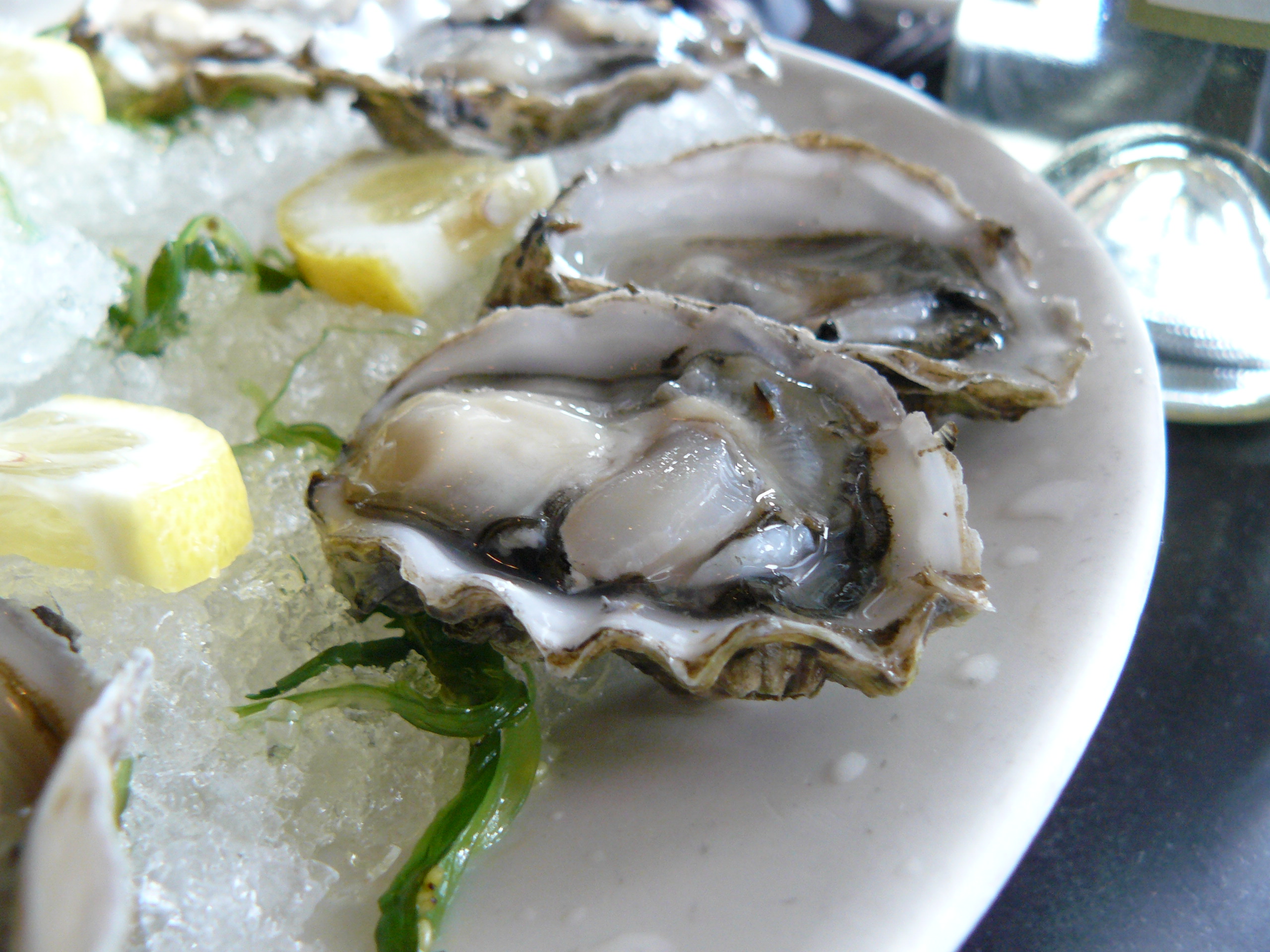
Equipped with a shucking knife, I got a lesson in prying open fresh Miagi oysters farmed in Tomales Bay.  With a towel as a buffer insert the blade into the hinge end and twist to loosen the shell.  It took all of my minimal arm strength and several shards of shell down my sweatshirt until each punctured shell yielded with a satisfying soda can pop.


According to Bioscience Magazine, the majority of native oyster bays are “functionally extinct.” The Center for Biological Diversity claims oyster the die-offs along the Oregon and Washington coasts are the direct result of ocean acidification caused by higher CO2 emissions.
Nearly all of the oysters consumed globally are farmed.  With a natural filtering system, these mollusks are ideally suited for aquaculture.  High in iron and potassium, oysters are commonly known as aphrodisiacs due to high concentrations of zinc.  Buy shellfish live.  When agitated, clams and mussels will close.  Cook until the shells open and discard those that don’t.
“How are you with a cleaver?” Miserably I looked from Pete to a pair of cooked crabs waiting on the chopping block.  Two deliveries had arrived within five minutes of each other, it was lunchtime and there was crowd of customers waiting to be served.  No time to be squeamish.
The rule of the fish department: keep it simple, do it, do it right and do it fast.  With practiced ease, the rest of the crew calmly filled orders, sidestepping delivery boxes and dodging bits of fish gut sailing into trash bins.
“Just follow me,” said Pete, deftly disconnecting the crab’s body from the top shell.  My shaking hands did nothing to speed the dissection, scraping off gills and twisting off mouthpieces.  Once the remaining guts were sprayed away, legs were snapped off and cracked with a series of well-placed taps of a mallet and the body cleaved into six pieces.  Time to help the next customer.


Monday, May 14, 2012

wild or farmed?


Not my favorite part of the article, but wild and farmed fish are such a big issue...

Sustainability is a central factor in in the buying process for sides of the counter.    The difference between farmed fish and their wild counterparts is one of the most common question customers raise, all part of the larger debate over environmental sustainability and human health.
On the up side, farmed fish typically contain lower levels of mercury.  Farmed also has the benefit of year-round availability in addition to a lower price tag for consumers.


The US is one of the largest importers of farmed salmon. Yet the 2004 Monterey Bay Aquarium Seafood Watch Report recommended avoiding farmed Atlantic salmon.  Farmed Atlantic salmon touched on the bigger issues of aquaculture: pollution and disease, escaped fish into wild populations and unsustainable feeding practices.
But the alternative may not be a sustainable option either.  High prices for wild tuna indicate the environmental costs of tuna fishing.  Removing young tuna that have not yet reproduced puts obvious strain on a struggling population. In addition, unsustainable fishing methods raise the problem of bycatch and its detrimental effects on other marine species literally caught up in the net. 
  “Wild isn’t necessarily the better fish,” Pete says reasonably.  Idaho-farmed Rainbow trout for instance is recommended by the Monterey Bay Aquarium Seafood Watch as the best “ecological responsible” alternative for wild-caught lake trout. Full of beneficial omega-3 fatty acids and low in environmental contaminants, wild Alaskan salmon and farmed rainbow trout are equally promoted by the Environmental Defense Fund.  The debate between farmed and wild comes down to personal conviction and awareness of the pros and cons of each practice. 

Sunday, May 13, 2012

dealings with eggs, livers, heads, etc.


Fish days continued...

After proving my worth with a spoon I got upgraded to a metal scaler—a coil of serrated rings for sending kampachi scales flying in all directions. Kona kampachi is a new sashimi-grade fish sustainably farmed in Hawaii since 2005.  Prized for its fat content of thirty percent and minimal fishy flavor, kampachi can be served raw, baked or steamed. 
Along the counters, the crew was busy cracking crab legs, inspecting monkfish livers, carving up tuna blocks and filleting mackerel.  After pinching the heads off a bucketful of smelt, it was back to the spoon to scrape at what was left of a large salmon.  My next task was a clean process: packaging bright orange salmon roe (ikura) and wasabi flavored flying fish eggs (tobiko).  At the next table seven salmon heads are being split beneath a mallet-driven cleaver.  With admirable patience, the fish boys put up with my slow progress, keeping a wary eye out in case the gritty work made the new girl vomit. 
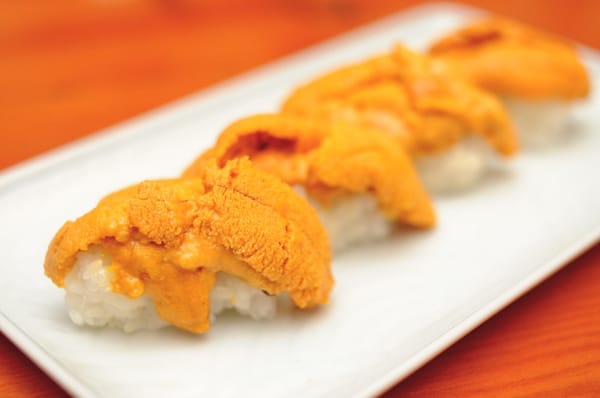
            Slightly smaller than the state of California, Japan has more than 18,000 miles of coastline.  Of the many delicacies featured in Japanese cuisine, one in particular can be found off California’s coast near Santa Barbara.  Uni, the reproductive organs of red sea urchins, look like mustard-colored tongues with a smooth, buttery taste. Santa Barbara uni is harvested by divers and sold throughout the state, but the top quality specimens are shipped off to Japan’s fish market in Tokyo.  When choosing uni, look for firm pieces without areas of drying or discoloration. 

            The Washington state coast also offers up a rare culinary find.  Mirugai in Japanese, the geoduck is the world’s largest burrowing clam often prepared raw as sashimi. Monkfish liver (ankimo) and salted, dried herring ovaries (kazunoko) are other delicacies for intrepid foodies to try out. 
How do you know if a fish is fresh?  Smell it.  At the register, we cashiers cringed away from bags of fish heads and grimaced at a waft of shellfish escaping from a bag.  Behind the fish counter, I was unfazed by the sight of dissected sea creatures with their open mouths and vacant eyes.  With all of the visual distractions like the arrival of 30-pound side of tuna, the role of smell takes a back seat.  In a place so numbingly cold, it takes awhile to pick up on scents beyond the initial waft of bleach.  Although counterintuitive, fresh fish does not smell fishy.  A can of fresh scallops, for instance, should in fact smell like canned corn.  


I always wondered why Pete called out "corn!" (read fresh!) when opening up a batch of scallops.   

Saturday, May 12, 2012

big fish, big price


Tuna, so yummy yet such a guilty pleasure.  Yes I feel bad supporting an unsustainable branch of the fishing industry but raw tuna is just so good.  Nine months ago I wouldn't eat raw fish of any kind...things change.  Anyhow, the story continues...

While the deliveries arrived, I got busy scraping.  Expecting to use a knife to salvage the thin layers of tuna from the skin, I was surprised when presented with a well-used, slightly dented metal spoon instead.  Every bit of tuna is used: the best sections are sold as whole steaks while the rest is parceled as sashimi blocks or pieces.  When making sushi rolls, one pound of tuna or hamachi pieces is enough to fill ten rolls.
...
For sashimi grade tuna, fat content determines quality and consequently, price.  The highest concentration is found in the tuna belly or toro meat, which goes for $45 per pound. The center or akami cuts are less oily, yielding the reddest meat thanks to the protein, myoglobin. 
As a big fish at the top of the food chain, tunas also top list of mercury-tainted seafood.  The 2004 consumer advisory by the Food and Drug Administration with the Environmental Protection Agency stresses the benefits of seafood as a source of essential proteins and omega-3 fatty acids.  For fish with elevated levels of mercury like bluefin tuna, lingcod and opah, the Environmental Defense Fund suggests substitutes like mahi mahi, US catfish, Pacific halibut or Canadian albacore.
While the debate continues over the sustainability of tuna fishing, maguro remains a lucrative force in the global market.  January of this year saw the record-breaking sale of a 593-pound bluefin tuna at Tokyo’s Tsukiji fish market for $736,000. 

Friday, May 11, 2012

more fishy tales


Another part of the ongoing feature article/behind the scenes of a fish market.  I got a great quote but didn't write it in: what sells the most?  The answer: "sashimi--they buy it like crack."

Although the rest of the coffee-toting crew wouldn’t arrive until 10, the early shift had been busy since 7am setting up, re-icing and carrying out quality checks.  Pete, 26, has been starting his early mornings with trays of fillets and the crunch of ice for three years now.  He sets high standards for the daily quality check.  In between trips to the refrigerator, he filled me in on the market’s supply technique.  “Keep a good rotation,” he said, setting down a box of iced fish and pushing his glasses up his nose, “you’re always gonna want to think one step ahead.”  This involves keeping track of the fishing seasons and consumer trends.  May starts off the season for local salmon, the market’s top seller.  “People like to support local,” said Pete who recommends alternatives like local cod as more sustainable choices to threatened species like his favorite, Chilean seabass. 


Although its name would suggest otherwise, Chilean seabass is not a fish exclusive to Chilean waters.  According to the U.S. Department of Commerce, the US imports twenty percent of the global Chilean seabass catch—the majority, outside of Chile, from Antarctic waters.  Illegal fishing necessitates government regulation to ensure the species’ continuation.  Black cod and farmed white seabass are eco-friendly alternatives with equally high oil contents best prepared lightly grilled or pan-seared.  

Thursday, May 10, 2012

hopping the counter


A bit of my feature article...four mornings with the fish department, a ten week journalism course assignment and lots of stray scales.


Customers made their way along the counter, surveying the market selection of triangular blocks of deep red maguro tuna, pearly fillets of opah and bright salmon steaks.  Requests for live crabs, swordfish and clams could be heard above the grumbling ice machine and the metallic clicks of knives being sharpened. 
Taking a number from the bright red dispenser, one customer continued browsing.  What’s for dinner tonight? Bay scallops? Monterey black cod is on special today and oh, look, a fresh batch of Miagi oysters just came in.
Behind the counter, a crew of twenty-somethings is busy filling orders.  Half pound of the Shetland salmon, please.  It’s the lunch rush, with deliveries to be checked, suppliers to be called, and fish to be cut.  Could I get about a third of a pound of the rock cod?  What’s fresh today?
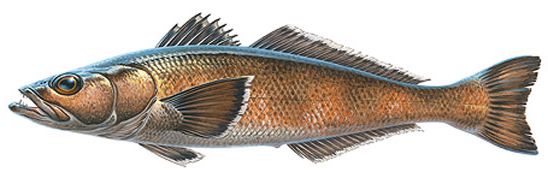
...
Of all the fish caught worldwide, seventy-five percent is for human consumption.  Billions of people depend on fish as their main source of protein, with Asian countries in the lead. When it comes to seafood in the US, the supermarket is closest some of us ever get to the ocean.  These days the process of getting fish from the water to the dinner table is shaped by the expertise of fishermen, suppliers, and retailers—and the choices of conscious consumers. 
...
The clock stamped with the San Francisco Giants logo read 9am as I made my way to the fish department wearing a grungy sweatshirt with old jeans and extra thick socks tucked into rubber boots.  Stainless steel work surfaces, sinks and black rubber mats gave the long galley a part-ship deck, part-laboratory feel.  In a few hours the area behind the counter would be bustling, the air full of banter—and flying fins and tails.   

Wednesday, May 9, 2012

London calling


Tickets are booked and the suitcase is packed!


It's been two years since I studied abroad.   A whole year in London-- with class only three days a week, a student tube pass and a cupboard full of jaffa cakes...


Jaffa cakes.  Quite possibly my favorite food during my time across the pond.  My suitcase is coming back full of them.


There's no point in packing and no use denying that I'm going to buy all new clothes.  Too bad about the exchange rate.


I want to be like Tim Baynes.  He's a British travel artist and his work is amazing, capturing the feel of the city and the people in it.

Check out his photosets.


Counting down the days until I'm on that plane heading east...


Tuesday, May 8, 2012

on to the next

With the journalism workshop at an end, I can reclaim my hours from editing and seemingly endless rewrites.  All and all it was a great experience--gave me an excuse to visit the city once a week and served as my way into a few sessions hanging out with the fish department boys.  


When the class started, I wanted to reform my research and editing ways.  Unfortunately I fell right back into the bad habits of research overkill and timid editing.  Knowing when to stop gathering information is the hardest part.  Editing is easy once I get myself into a foul enough mood, more willing to omit whole sentences.  


Blundell wrote that the writer is in fact two people: the artist who creates and the self-editor who ruthlessly picks away at the artist's work.  According to Michelangelo, "every block of stone has a statue inside it, and it is the task of the sculptor to discover." 


Last week saw the end of my nine month stint as a cashier.  Learned a lot, met a lot of great people and tried a lot of good food.  In the end my restlessness got the better of me.  What started as a temporary part time fill in job turned into forty hours a week-- including Saturdays--shorthanded most of which time, running around like a headless chicken, phone in one hand and receipts in the other.  Although I feel terrible about running off when I could be being useful, it's time to get out of town.  


Restless heart syndrome by Steph at Twenty-Something Travel...sums it up pretty well.