Tuesday, June 19, 2012

A new Berkeley favorite: PIQ

I love Google Maps.
Planning a trip to Europe--complete with airplane, sun and sailboat icons.  


All this fun plus pizza rustica and a double latte at PIQ (Pane-Italiano-Qualite) on Shattuck Square.
The man behind the counter was having a grand time watching the Ireland-Italy match on the tele.

Delicious pizza and amazing coffee, fast/free wifi, extra upstairs seating and plenty of people watching.

Monday, June 18, 2012

The Fashion World of Jean Paul Gaultier in SF


“The fragmentation of time.  That’s fashion, the passing of time.”


Last week we took a spin through San Francisco Fine Art’s exhibit of fashion works by Jean Paul Gaultier.  Right away you are greeted by a talking mannequin with the face and voice of the designer clad in his signature Breton stripes. 

on the wall

Born and raised in Paris, Gaultier drew inspiration from the Parisian street scene.  His work in the 1970s included can-can inspired dresses and collections drawing on London in the time of Vivienne Westwood.  Sci-fi themes also appeared in Gaultier’s pieces through the incorporation of materials like vinyl and neoprene.  In 1976, Gualtier ran his first runway show. 

detail: mermaid dress


Gualtier’s collections in the 80’s include nods to the traditional apparel of Eastern European, Asian and African cultures.  The next decade found the designer busy working on costumes for films. 


A few of the ensembles in the exhibit took over 200 hours to complete.  The “Dubar” camouflage gown worn by Sarah Jessica Parker in 2000 was constructed in 215 hours.  Gaultier’s 2008 “Calligraphie” gown was 295 hours in the making. 

image: Fashionable Fun

Gaultier’s fall 2009 show included dresses inspired by Hollywood’s leading ladies like Mae West, Greta Garbo and Rita Hayworth.  The Marilyn Monroe dress was sequined by hand, all twelve pounds glittering down the runway.   

Tuesday, May 29, 2012

bring your own mug


On May 20, 2011, Seattle resident Karin de Weille took on the mushrooming problem of disposable cups.  In the city of caffeine, this was courageous campaign for sustainable consumption.  According to the Seattle Times, several local movements and businesses showed their support including one coffeehouse chain that raised its reusable mug discount from 10 to 25 cents.  “Let's show that we can do this and our success will be duplicated in other cities,” Seattle City Council President Richard Conlin was one of the supporters of Seattle’s campaign to kick to habit of disposable cups.

            Every year, Americans use 56 billion paper cups (International Paper).  Of this staggering amount of waste, Starbucks alone discards 3 billion cups.  According to International Paper, “Less than 2 percent of Starbucks beverages are served in reusable cups.”
While disposable cups are convenient for the consumer on the go, they are detrimental to the environment with their petroleum-based plastic lining.  Not only does this part of the cup delay the decomposition of the paper components, it is also produced from non-renewable materials (International Paper).
In response to this problem, International Paper, in collaboration with Green Mountain Coffee Roasters, designed the “ecotainer” in 2006.  Instead of plastic liner, the ecotainer uses a modified biopolymer resin which can be composted and ultimately reused as landscaping and farming material.  Thanks to this development in sustainable distribution, International Paper claims more than 1 million pounds of petrochemical plastic never made its way into the landfill.  
According to International Paper, half a billion of its ecotainers negated the use of “enough petroleum to heat more than 32,000 homes for one year.”  Since 2006, ecotainers can be found everywhere including at the UC Davis CoHo. 
         Clearly these companies thrive on the consumer mentality of disposable convenience.  If we were all more eco-conscious instead of profit driven, each paper cup would come with a discouraging statement about the unsustainable methods of producing and disposing billions of paper cups for our convenience.

If you visit the CoHo every morning as I do, you dispose of five cups every week.  That adds up to 60 cups every quarter—assuming you don’t make a second trip in the afternoon after the cup you used in the morning has already been disposed of.  This routine adds up to 5 disposable cups per week, amounting to $8 worth of small coffees.  This quarter alone, fueling my caffeine addiction has cost a total of at least $96 and at least 60 disposable cups. 

Guilt campaigns against plastic carrier bags are making headway, some stores charge you for requiring a plastic bag, others offer discounts for bringing your own reusable bag.  If Americans can ditch the convenience of one-time-use plastic bags, we can make it a habit to bring our own reusable cups to our daily coffee fill stations.  While it may be a pain to cart around a dirty empty container after your morning dose, just think of how many disposable cups you will have saved.  While your reusable coffee mug is not the first thing you grab on your way out the door, there is still time to change our cultural addiction to convenience.  

Insomniacs and apple toast


First the insomniacs: our house is running on three time zones: Pacific, GMT and Bhutanese.  


The past few days I’ve been back on Pacific, especially after I went to work on Saturday.  Dad is on his retirement schedule of early bedtime, 4am walkabout and getting up around 8.  Mom on the other hand: she’s still in bed around 10 or 11 because she was up reading/eating at 3am, a consequence of going to bed at 7pm and napping at 2pm.  She honestly scared me one morning at 3—all excited that I was up to witness her fluttering around the kitchen.  I was just waiting for a psychotic laugh to follow.  For a while I was doing the wake up at 2 and 5am thing and lying around thinking until 7.  So for a few days Dad had to keep a low profile, having to contend with both Mom and me being sleep deprived grouches.   
 
Apple toast:

This morning I fried up some thinly sliced apples in butter, dusted with sugar and cinnamon and ate over toast with fresh coffee.  Yum. 

Twenty-Something Travel and TEFL:

I love the blog Twenty-Something Travel—and the manifesto to travel while you’re young.  After soaking up a lot of advice, I bought the extra 38,000 miles to get me to Brussels this fall.  I’ve been back in the States for less than a week and I’ve already got my next escape lined up.  

Next spring I want to do Asia, after hearing so much about it recently.  No joke: Mom went one better than bringing home an elephant: she brought back a wooden penis, hand carved no less.  Apparently they’re everywhere in Bhutan to ward off evil spirits—as road posts, on temples, fountains… Where on earth is she going to put it?  Well it was on the kitchen counter while Dad and I were reading the paper/eating breakfast, trying to ignore it. 

Anyhow, since I haven’t done Asia yet I figured I might as well go on a TEFL program.  That way I can see a few countries and actually live there and see real people and help out/get certified.  It sounds better than taking methodology classes in Canada during November, although that option is still on the table.  


I've been listening to French language cds trying to brush up--mainly trying to beat the program in verb conjugation...  

Monday, May 28, 2012

coffee health pt 2


Academics such as Professor Roland Griffiths warn against abusing caffeine’s benefits.  A Johns Hopkins professor of psychiatry and neuroscience, Griffiths told Time Magazine that for coffee binge-drinking students especially, “the stress of the deadline can be exaggerated by the caffeine.”  Research conducted at Duke University suggests that your morning dose does its work to keep you awake for 12-16 hours before needing a revival (Time Magazine, “The Newest Addicts on Campus”).  At this point, you feel groggy and go to bed.  During sleep, the body is deprived of caffeine, making mornings especially difficult, only to be remedied by the much-needed morning dose of caffeine. 
This never-ending cycle is maintained by the body’s constant craving for caffeine and the ups and downs of withdrawal.  Drinking coffee, then, according to Jim Lane at Duke University, is necessary to “restore normal functioning rather than to feel more alert than usual” (Time Magazine, “The Newest Addicts on Campus”).


 A study by the Journal of American Diabetic Association revealed that 90 percent of adults consume caffeine every day.  Caffeinated beverages are clearly no longer simply symbols of upper-middle class leisure; we have become a culture desperately dependent on the coffee bean as a commodity, self-consciously perpetuating the cycle of withdrawal and temporary relief.
Whether you are hitting the books, procrastinating, or catching up with other sleep deprived friends, just remember: that cup of coffee connects you to a network of global trade and centuries worth of beans ground and consumed by fellow idlers across the globe.

Bargain Hunter's London


 A pile of dresses on the bed, boots and flats under the desk, jackets hanging in the closet and a collection of shirts on top of the tv.  I had made the mistake of waiting until my last night in London to pack a week’s worth of souvenir and bargain hunts.  With suitcase stretched beyond capacity, I made it home with a whole new wardrobe thanks to the high street and East End thrift markets.


The East End:

I love London’s east side—a year spent wandering the twisted streets revealed little pockets of good food and good shopping.  At first glance, the East End looks considerably rougher than the clean facades of London’s western postcodes.  Historically characterized as the immigrant and working-class region of the city, the East End is dynamic, ever surprising place to explore. 

Sunday is the day to be wandering: start at Liverpool Street Station and head east to Spitalfields Market.  There you can find stalls selling hand-printed shirts, vintage scarves, old books, posters, vinyl records and delicious pastries.  A session of digging through crates of dresses and skirts followed by coffee and an almond croissant is a great way to spend the morning.
Make sure to get cash the night before—there are only a handful of cash machines near by and they often run out of money.

A few blocks away is Absolute Vintage—a more organized vintage shopping experience.  Just next-door is the Sunday Up Market.  On Sundays, the nondescript parking garage is turned into a bustling market of new and vintage clothes.  Get there early to avoid the lunch crowd heading in to sample the food stalls cooking up pad thai, green curry, sushi, crepes, cupcakes and more. 
 
Just outside is Brick Lane, the curry center of London.  Together with street vendors, little shops offer books, shoes and other curiosities.  For heavily discounted high street clothing, head down Petticoat Lane.  While bargains are plentiful so are pickpockets.  If you don’t mind a challenge, Petticoat Lane has some good buys to be found.  I got a navy blue pea coat with toggles for $15. 

Camden Lock Market:

Like Notting Hill’s Portabello Road market, without the antiques.  Known as the goth/punk scene of London, Camden is full of costume and specialty shops.  Unlike the East End, Camden’s market is open on Saturdays.  Past the sunglasses and t-shirt shops is the canal.  Here you can find the food stalls with samosas, eggrolls and chocolate-filled Brazillian churros.  The winding passageways beyond are packed with people and little shops.  I have found dresses for $8, unusual necklaces and piles of oversized sweaters (aka jumpers). 


Oxford and Regents Streets:

The bustling high streets with Topshop’s multistory flagship store, Selfridges, Hamley’s toy store and much more. If you want to avoid the crowds, Kensington’s high street further west has many of the same shops.   Primark, at the very end of Oxford Street, is one place where crowds cannot be avoided—two floors of trendy, medium quality clothes at low prices creates a shopping frenzy.  It’s all too easy to get sucked in, but if you’re selective you can emerge from the madness with some good finds.  Knowing there are obscure brands and unique vintage pieces just waiting in the East End, I like to wander the high streets and people watch.

 Clearly I’m biased to the East End,  but it’s definitely worth a Sunday morning if ever you find yourself in London—just make sure to save some room in your suitcase.  


Sunday, May 27, 2012

caffeine and health pt 1


The UC Davis CoHo is proof that the coffee culture continues to thrive.  Ed Andrade, who orders the coffee supply, substantiates this statement: every day, the CoHo consumes between 130 and 140 pounds of coffee beans. 
College campuses are ideal settings for the coffee market: with stressed out, sleep deprived students working to meet deadlines, caffeine is often central to the period of crash studying proceeding the week of exams. 

In 2006, Northwestern University conducted a study of 265 incidents of caffeine abuses reported to the US Regional Poison Control Center between 2001 and 2004 (Time Magazine, “The Newest Addicts on Campus”).  Most surprisingly, the average age of the subjects admitted was twenty-one years old.  “People are less aware of caffeine as a drug than they are of alcohol and other recreational drugs that people come upon in college,” says Duke University’s psychophysiology lab director, Jim Lane.  Caffeine is the world’s “most popular psychoactive drug” according to sources such as National Geographic. 
The 2011 Food & Health Survey conducted by the International Food Information Council Foundation examined consumer attitudes regarding topics of nutrition, health and food safety.  This study quoted the majority of Americans (69 percent) as moderate consumers of caffeine.  The size of the “average” cup of coffee in such studies has been critiqued as notoriously vague, ranging from 8- to 12-ounces. 
Time Magazine’s “The Caffeine Habit” published government statistics citing 60-120 milligrams of caffeine for every 8-ounce cup of brewed coffee.  For those of us who have built up a tolerance for caffeine, our bodies require higher and higher doses to achieve even the slightest effect.  The average coffee consumer may be ingesting over 300 milligrams of caffeine everyday.  In contrast, those who drink coffee less often can perceive a physical or emotional change with 1.5 ounces of strong coffee—a caffeine intake of a mere 20 milligrams according to Jeffrey Kluger of Time Magazine.


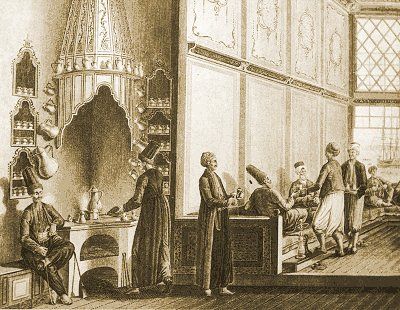
The first caffeine addicts in the cultural centers of the Ottoman Empire described the physical effects of caffeine as marqaha, defined by an increased heart rate and maybe even a temporary feeling of euphoria (Hattox).  Avid coffee drinkers today are more familiar with the withdrawal symptoms of fatigue, irritability or a pounding headache.